
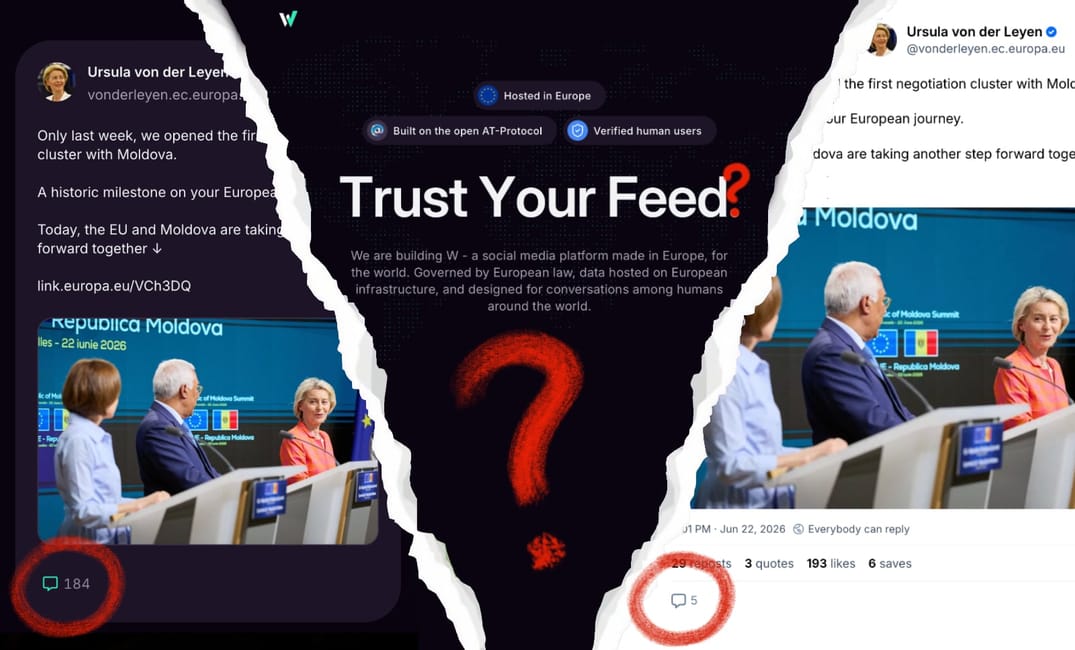
The new social network W Social - which purports to be a healthier alternative to Elon Musk’s X, “made in Europe, for the world” - would be a fascinating case study for future business school seminars. Its debut has been messy, filled with controversies - and yet, it has been embraced by high profile personalities from the worlds of politics and journalism. I am about to cover its biggest scandal yet, which puts into question W Social’s core promise: “Trust your feed”.
A quick recap
W Social was announced out of nowhere at Davos this past January. The media frenzy around its soft launch was awe-inducing: European decentralized networks like Mastodon or Eurosky never received a fraction of the attention W Social commanded - even if at the time W Social didn’t have a single user and kept details about its technical infrastructure secret. People quickly found evidence that W Social was a hard fork of the open network Bluesky, based on the AT protocol. Weeks before its beta launch it quietly went closed-source - at the same time as it was embraced by the crème de la crème of European institutions, politicians and NGOs for fostering “European digital sovereignty”.
I have published a series of exposés about W Social - including the scoop last week that the network had quietly gone closed-source. My research has been widely quoted in German, Swiss, French and Dutch media. The tide is beginning to turn, with more critical eyes observing W Social’s operations. If you want to catch up on all my articles about W Social so far, you can find them here:
 Elena Rossini
Having become an unwitting W Social expert, I can reveal there are several scoops that I have yet to publish concerning falsehoods and critical security issues; I am receiving tips on a daily basis. Today, I’ll cover W Social’s misrepresentations about their network’s metrics.
This article represents my personal opinions, commentary, and conclusions formed through independent research using publicly available sources. Any characterizations, interpretations, or inferences are presented as opinion, not as statements of objective fact. Readers are encouraged to review the referenced materials and draw their own conclusions.
Fictional Numbers on W Social's Homepage
A source tipped me off about the discrepancy between the metrics displayed on W Social’s landing page - which shows posts from its network as floating cards - and the real numbers of interactions when one checks the original messages on ATproto.
My source said:
The number for the comments seemed suspicious to me so I checked them against the Bluesky app. They apparently boosted the comments counts to make it appear like there is A LOT of discussion on W. This is so pathetic.
I checked the screenshots the source shared with me and then I went to verify the landing page of W Social and compared user metrics against the same posts on bsky.app. It’s true. The number of comments on posts by the likes of W Social CEO Anna Zeiter and the president of the European Commission Ursula von der Leyen are not a reflection of reality, but made to appear higher (I have the distinct feeling that a W Social intern is about to be blamed for this incident.)
A post by Anna Zeiter about her recent appearance at the Cannes Lions conference shows 22 comments on W Social’s homepage; in reality they is only one (as seen on ATproto):
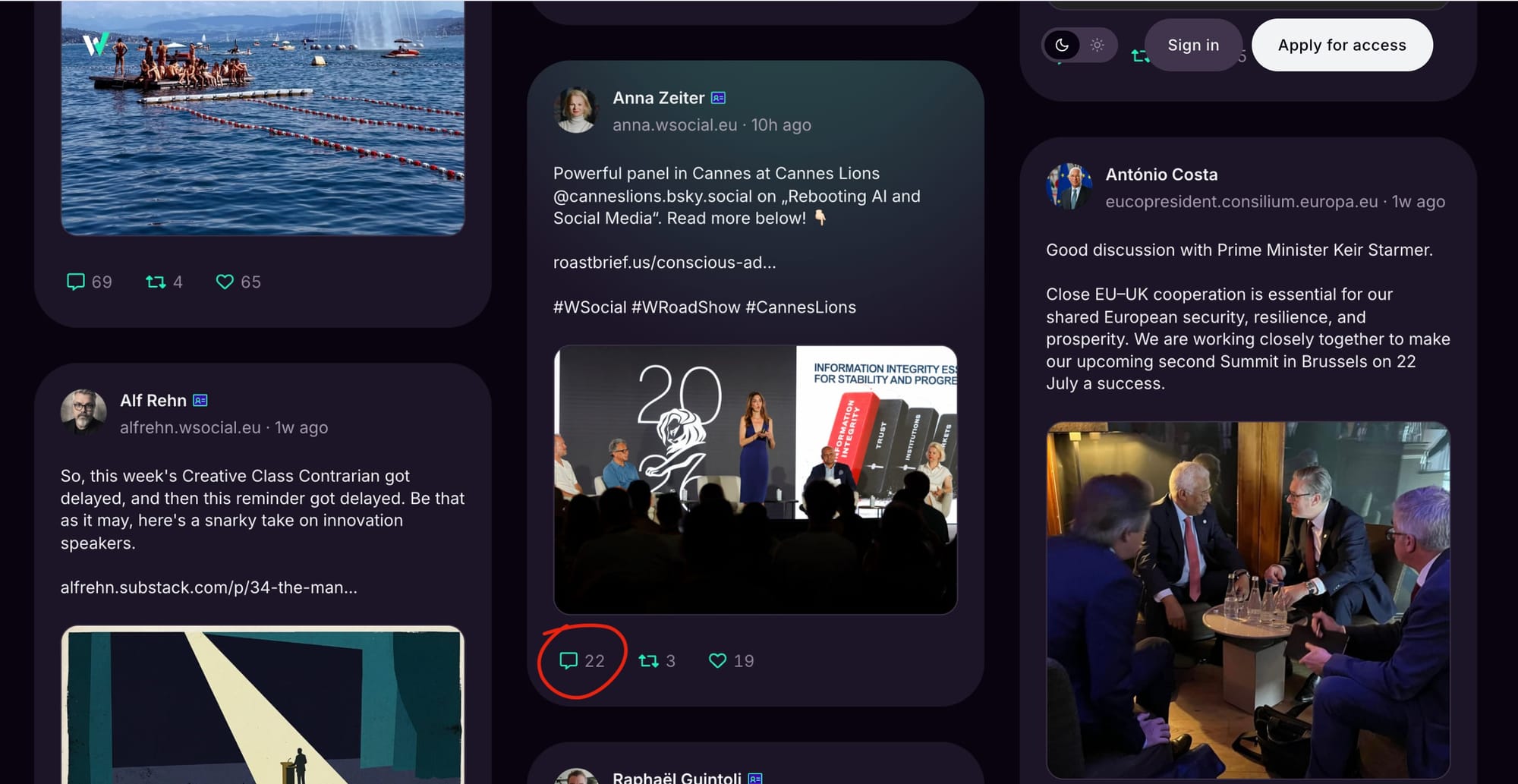
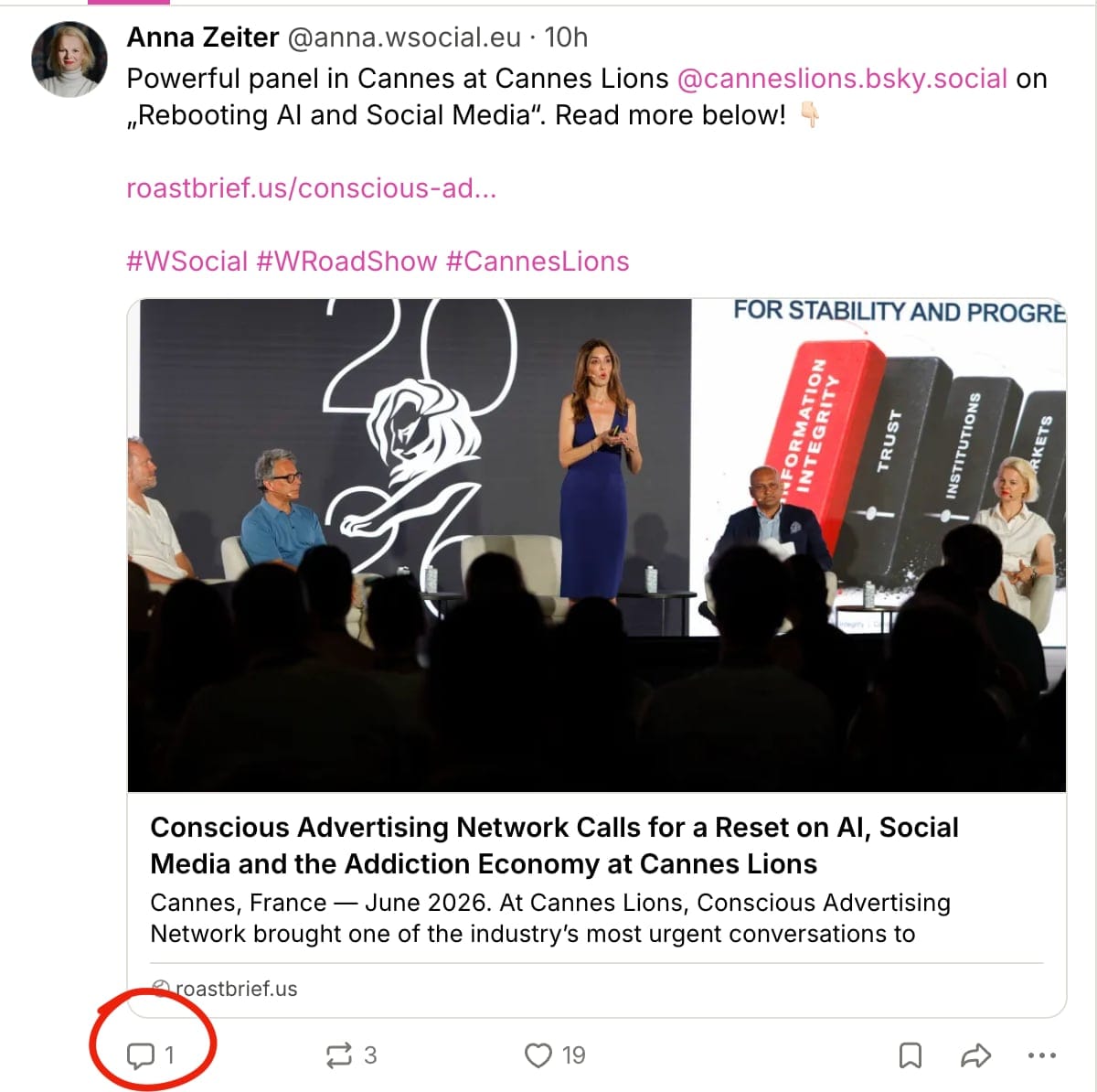
left: a screenshot of W Social's landing page showing a post by Anna Zeiter with 22 comments; right: a screenshot from Bluesky showing the post only has 1 comment
A post about Moldova by European Commission president Ursula von der Leyen shows 184 comments on W Social’s landing page; in reality there were only 5 comments on ATproto (reference post via mu.social):
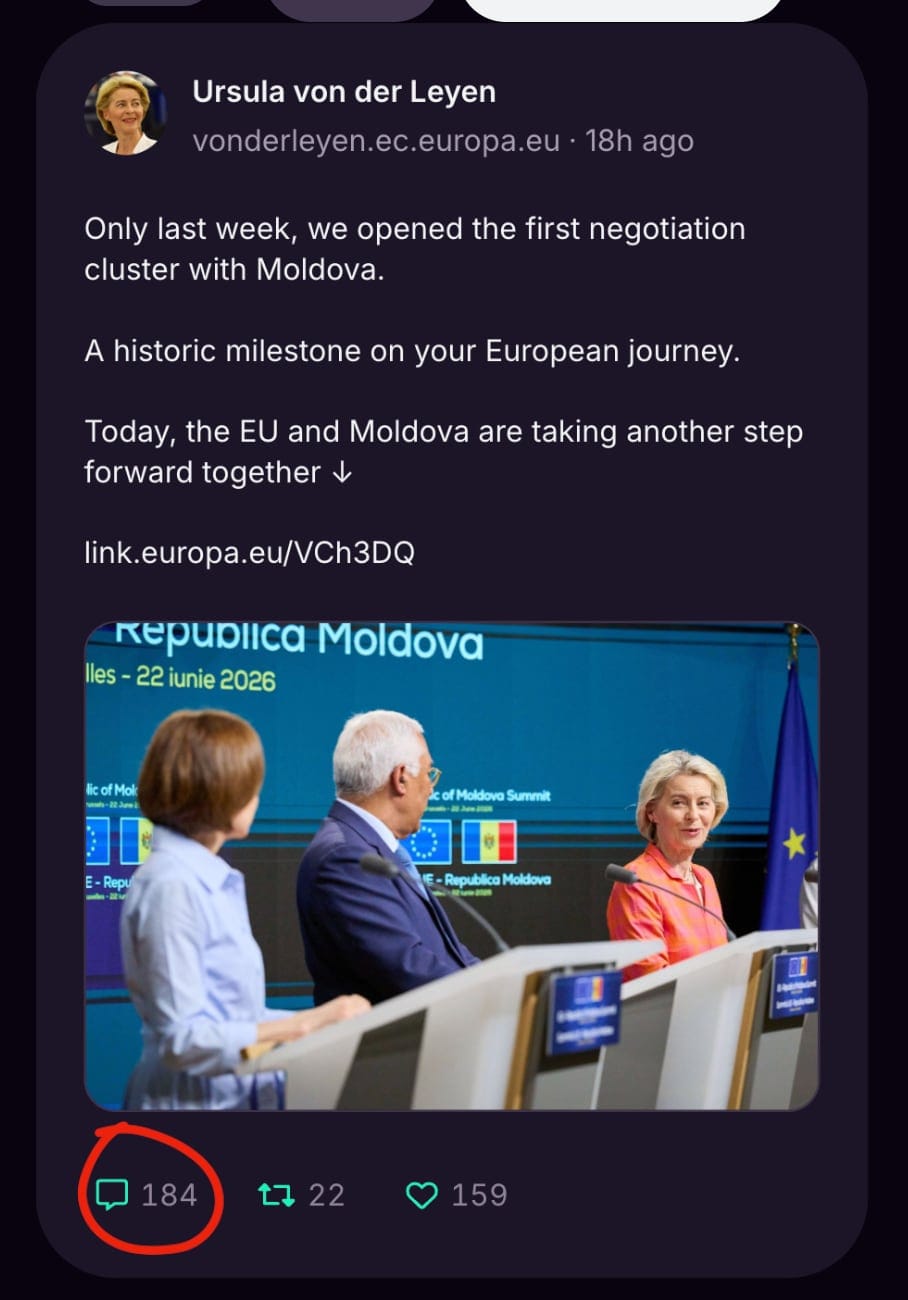
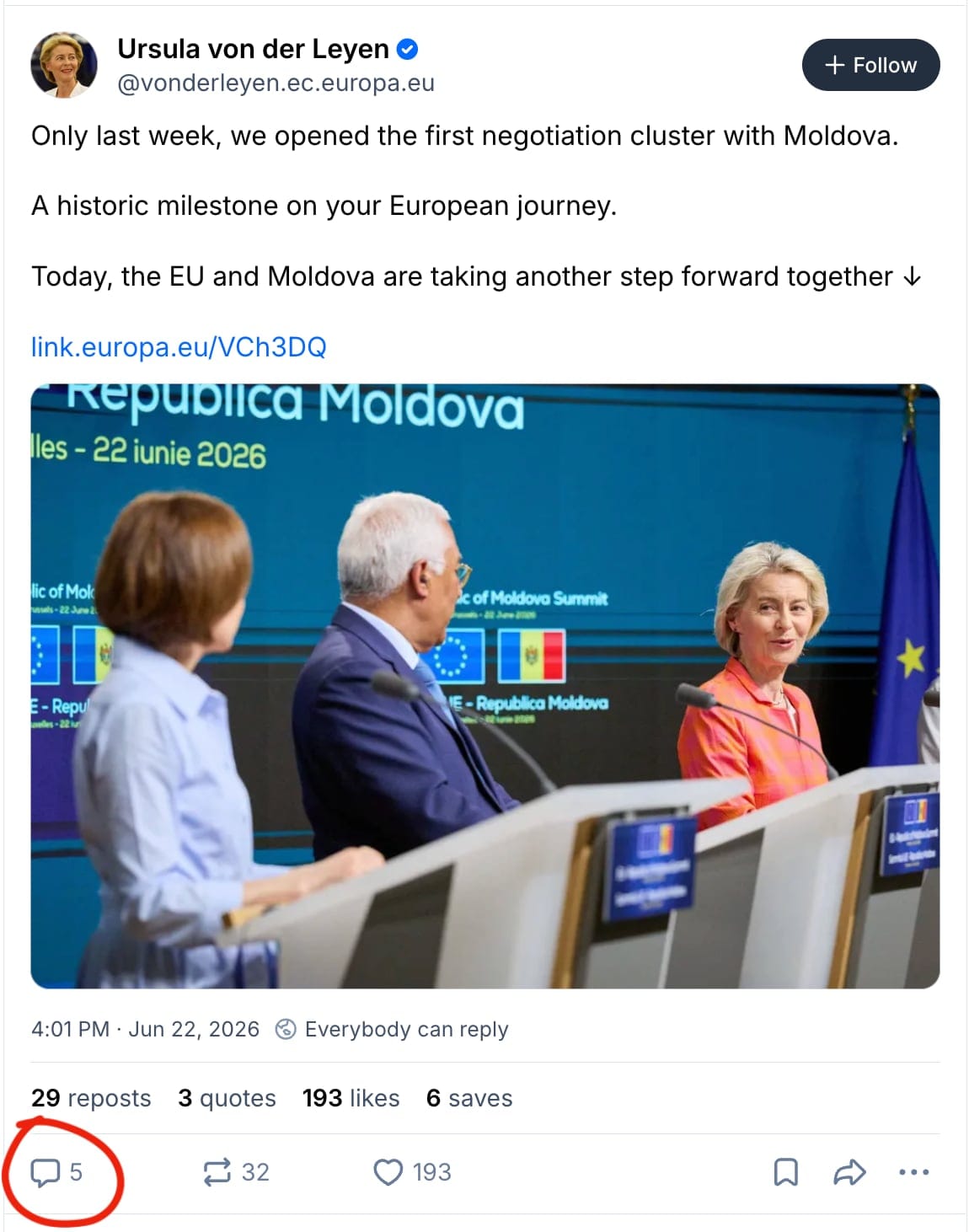
side-by-side screenshots of the same post by Ursula von der Leyen. There are 184 comments showing on W Social's homepage, whereas in reality the real number of comments is 5
These are only two recent examples, but most posts showcased on W Social’s landing page have fictional metrics that do not reflect reality.
W Social’s misrepresentations are concerning and at odds with the fact that W has become a central network of communication for the European Commission, the European Parliament and the European Central Bank. European Commission president Ursula von der Leyen took time out from her G7 meetings to advertise the launch of W Social last week - causing a bit of an uproar.
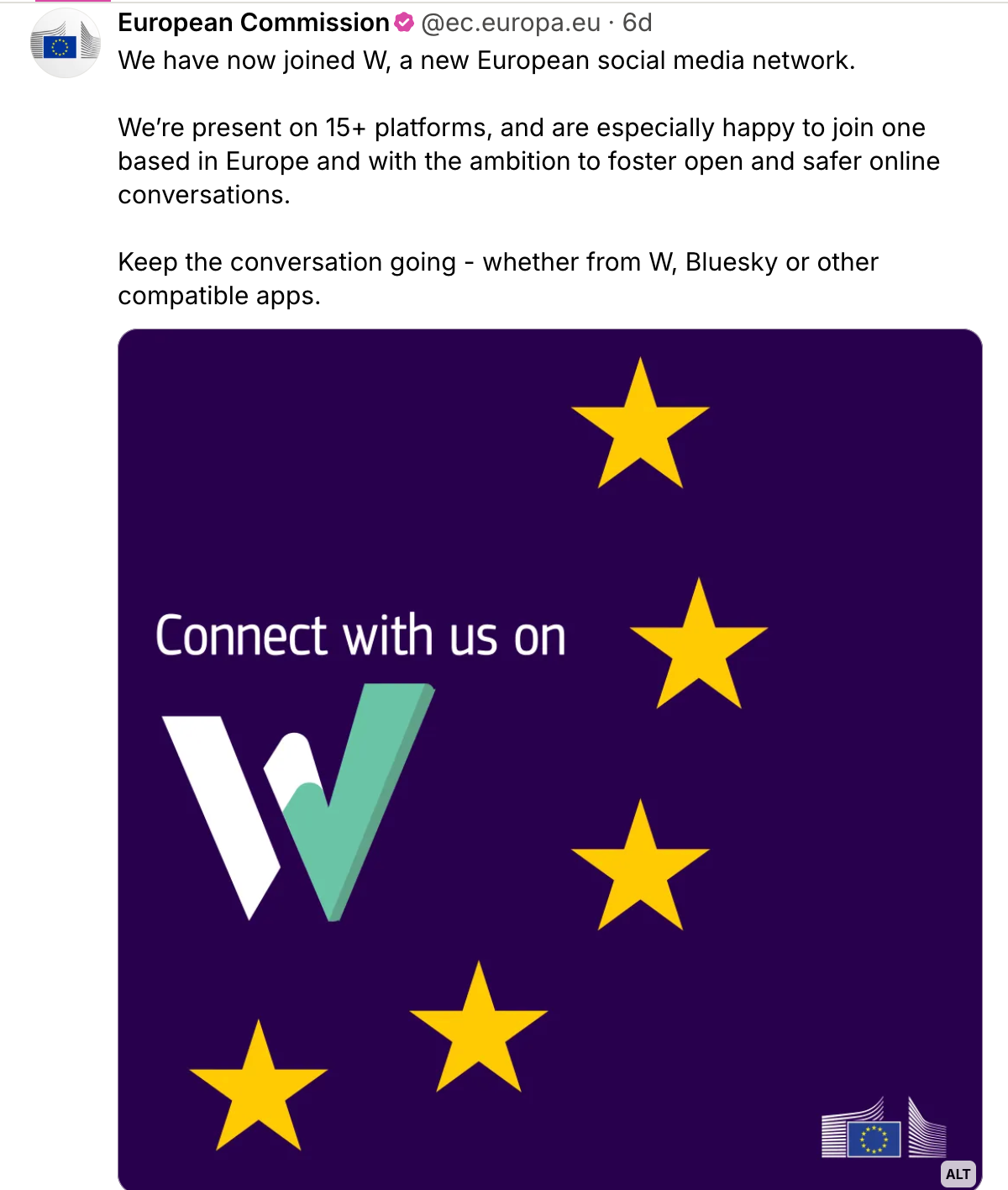
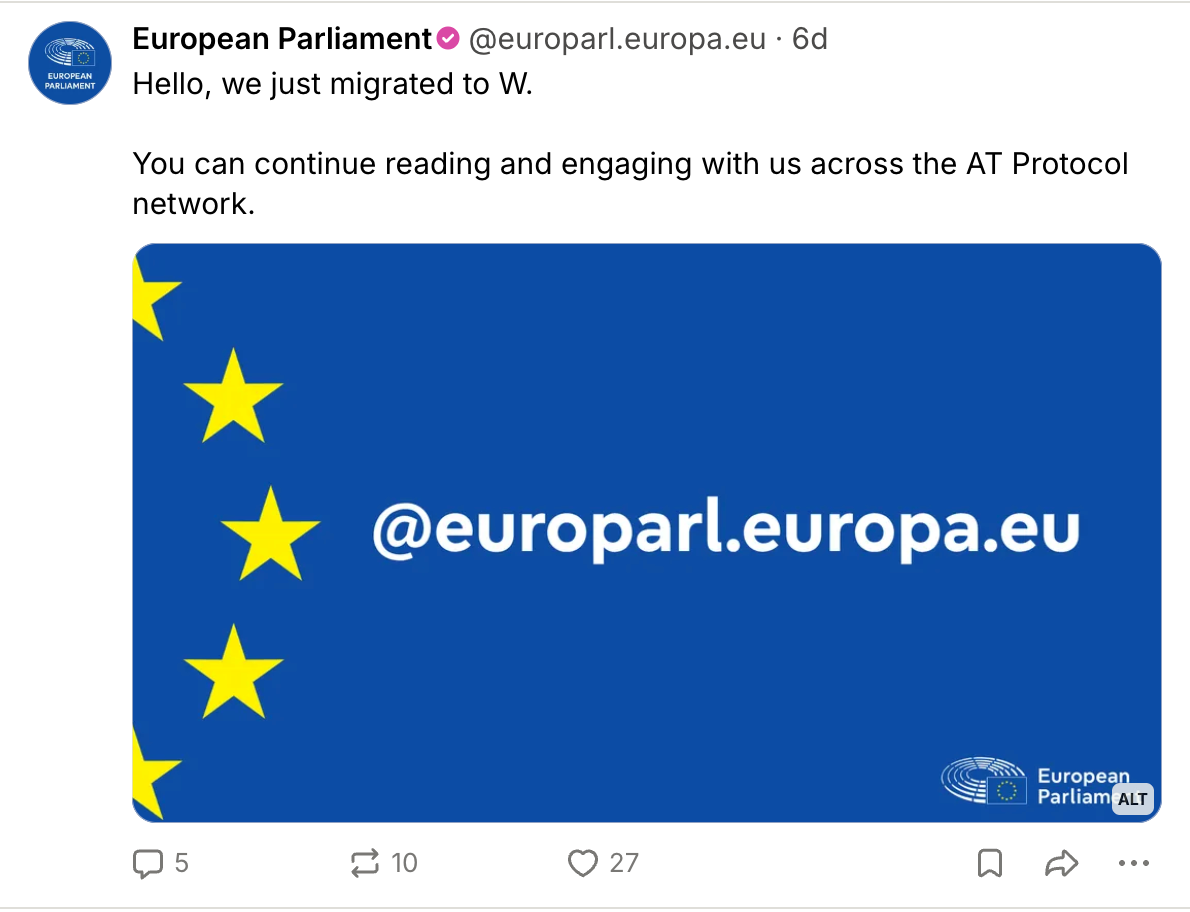
screenshots of social media posts by the European Commission and the European Parliament announcing the migration of their Bluesky accounts to W Social
Trust Your Feed? Trusted European Platforms?
The irony is that W Social’s tagline displayed in a huge headline on its landing page is “Trust your feed”.
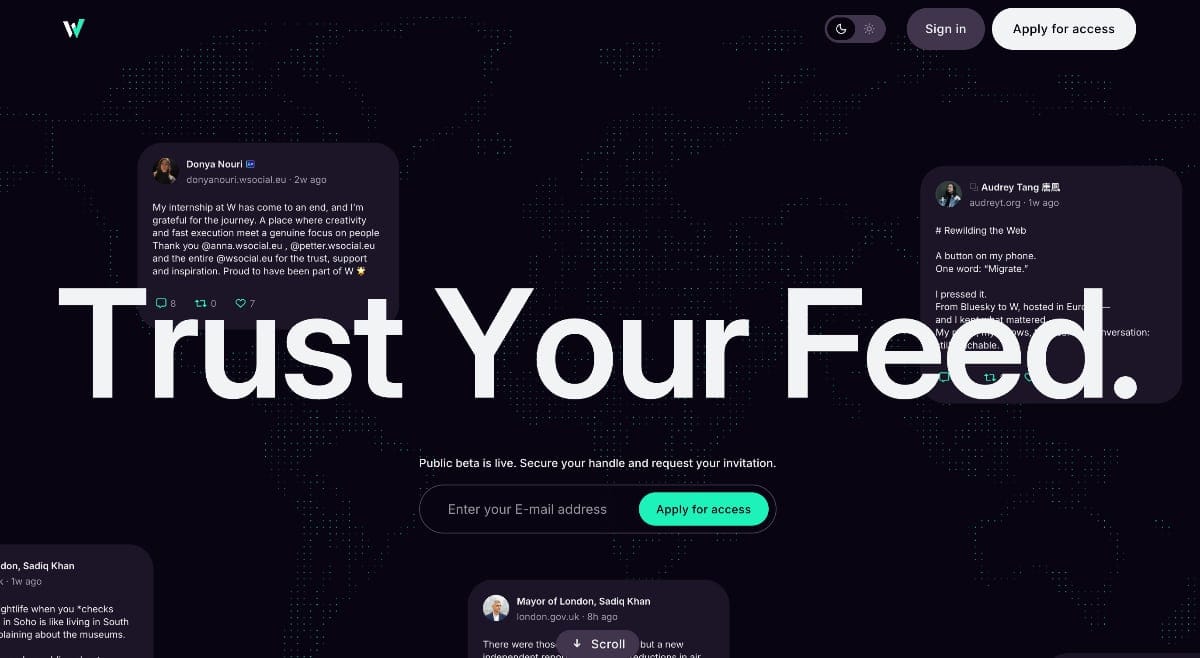
Copy on its homepage states:
We believe in the need for a global, trusted social media platform owned, run, and hosted in Europe. W is built on verified human users, transparency, privacy, and free speech.
“Trust” and “values” are often evoked by W Social marketing materials. And the company has been featured in multiple presentations about “Trusted European Platforms.”
 Christophe Leclercq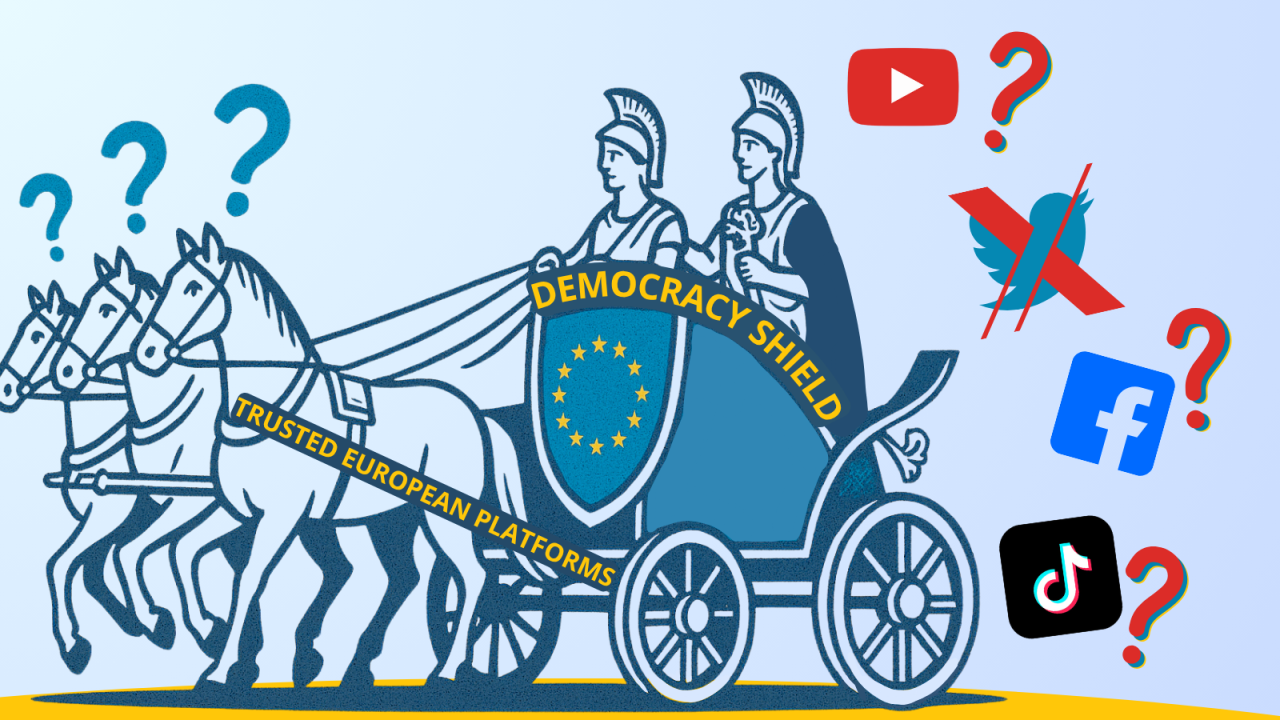
W Social advisor and investor Christophe Leclercq has created this label, which aims to help promote European platforms. The cover page of the project’s pitch deck describes the initiative this way:
A TEPs LABEL TO HELP NEW SOCIAL MEDIA FROM EUROPE
- selecting most promising ventures: trusted & staying in European hands
- helping them cooperate to get to critical mass
- opportunities for news media groups and for impact investors
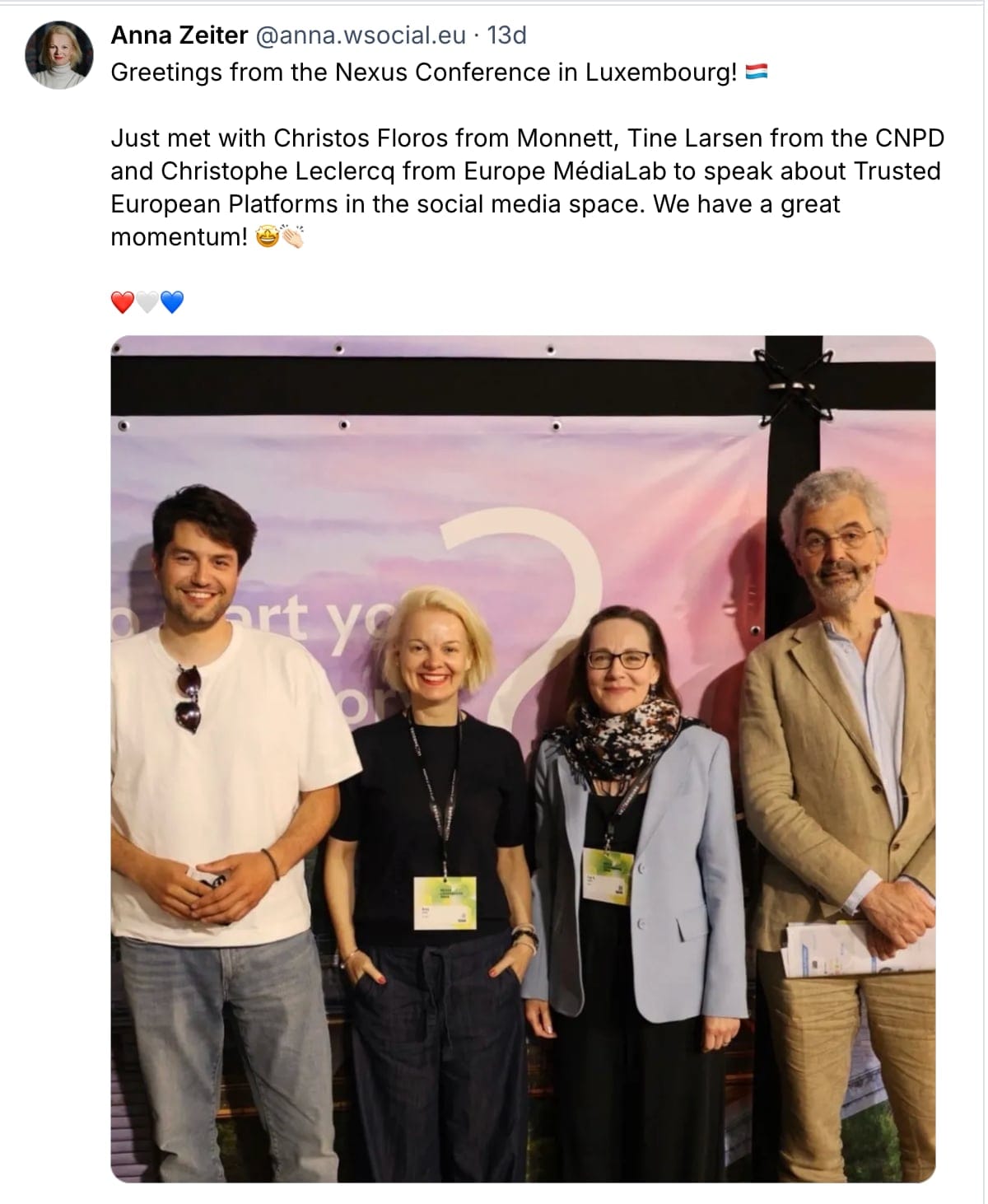
W Social is front and center in all presentations about Trusted European Platforms:
Ironically, at the label’s launch event at VivaTech in Paris last week, all the platforms represented on stage were closed-source: W Social, eYou and wedium:
 Nele Meissner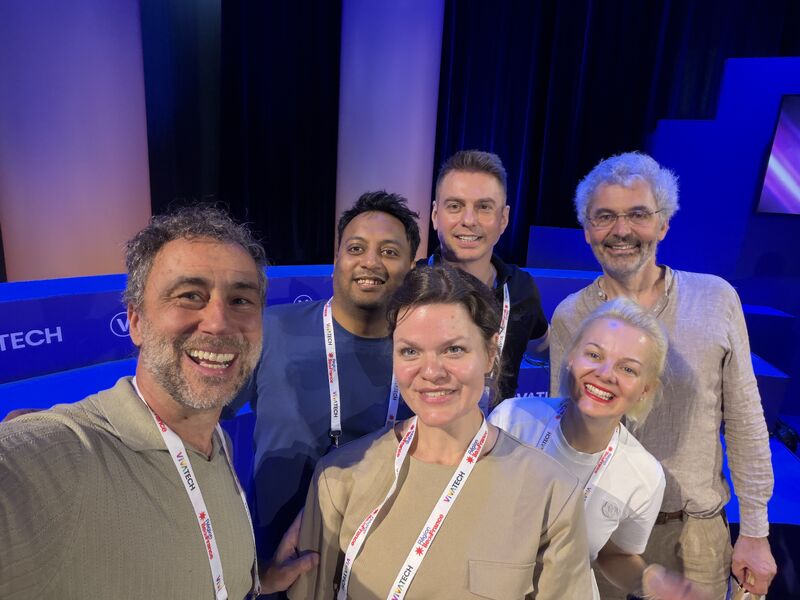
"Trust Your Feed" ... "Trusted European Platforms" ... And yet, W Social:
- grabbed open source code (Bluesky’s ATproto) and then quietly went closed-source, like Donald Trump’s Truth Social;
- displays the wrong comment metrics on its homepage, giving the impression that the user engagement is higher (than in reality).
Update at 16:00 CET
Someone on ATproto commented to this story, pointing out an interesting theory.
ATproto user @opfuchs.gay wrote:
This raises the question: where are these numbers coming from, then? Do you notice something odd? As others have pointed out, the "replies" are always greater than reposts or likes, which is strange. Also notice that they seem weirdly close to the sum of likes + reposts
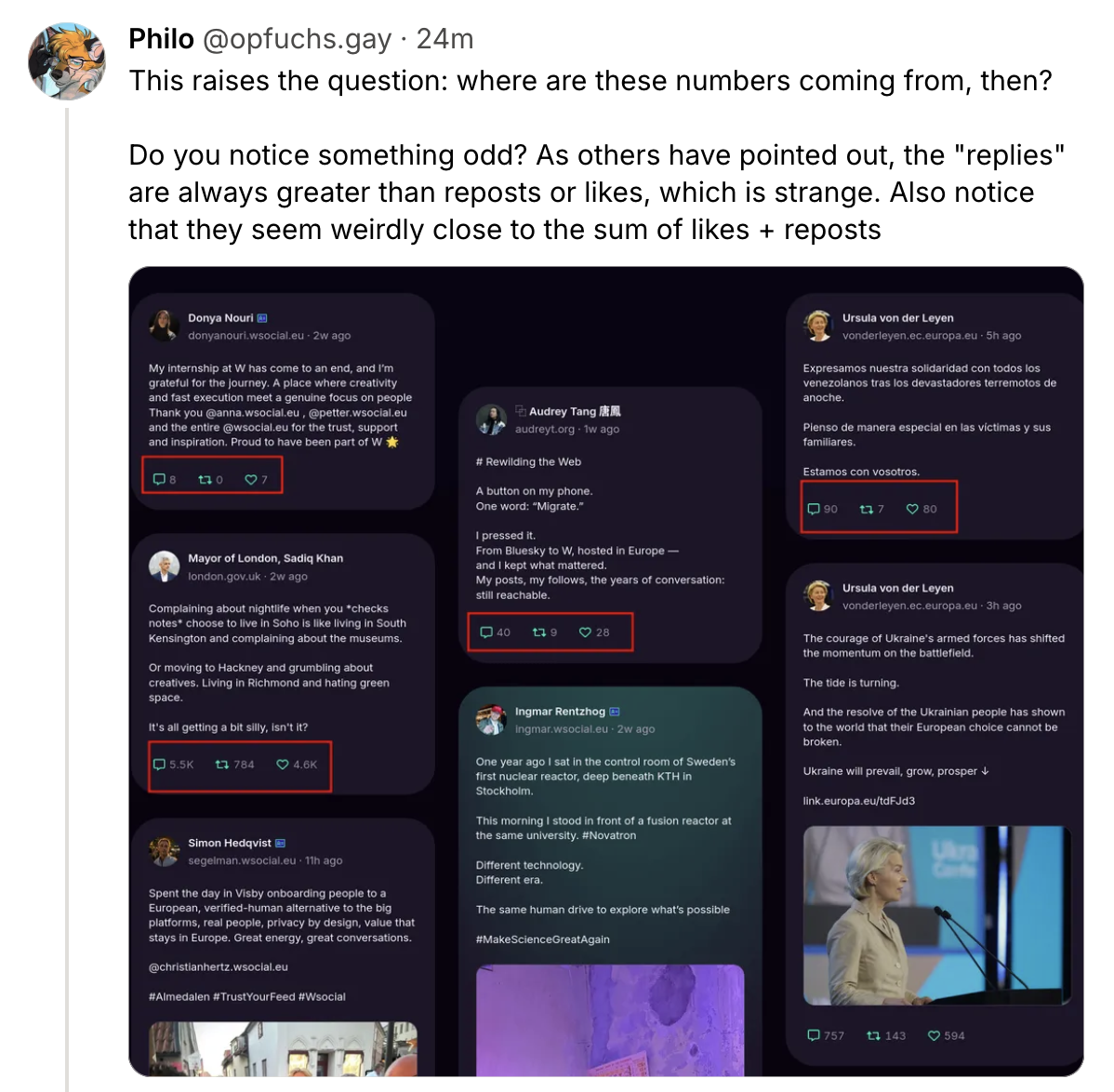
They continued:
Luckily this is a simple next.js app router, so we can mostly investigate this client-side right in our browser. The number next to the speech bubble icon is called "engagement." So it seems that they are calculating a total likes + reposts + replies server-side and putting it there. Something else interesting is that by looking at this event stream, it seems that the number next to the speech bubble then increments/updates only by actual replies. Having a total "engagement" metric consisting of likes + reposts + replies is itself perfectly legitimate. Putting that next to the speech-bubble icon under a post (as opposed to replies) is... a choice. Doing that and then live-updating the number only by new replies starts to look bad. I should also note that it is of course *possible* this is a mistake, and e.g. the engagement variable was meant to be involved in the showcase logic but not hooked up to the reply icon.
Indeed, all this could be a simple mistake.
Still, the question remains: would you consider W Social a Trusted European Platform? Would you still trust its feed?
July 9th update
After direct email correspondence with executives at W Social - where I wrote to them about the misleading metrics - it appears that the issue has now been resolved, with the icon for comments reflecting the real comments on posts - and not an engagement metric.
As always, thanks for being here (and for all the leads!)
Elena
